Benny Aviña, Oldenborg Dining Hall Employee
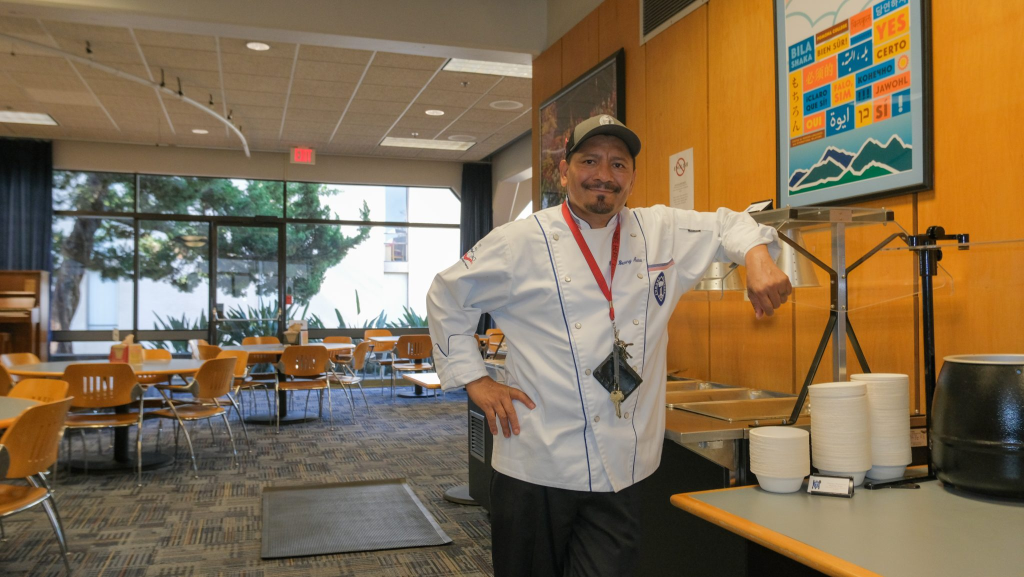
Maggie: Okay, if you can just tell me your name, how long you’ve been working here, your experience working here, and any memories you have.
Benny: Yeah. Well, my name is Benny Aviña, and I’ve been working at Pomona for already 40 years.
Well, I think it’s a great thing. I think it’s a great thing. I have a lot of experience here, and I’ve been working here for too long as well, in this kitchen, in this particular kitchen. But I think we really need to get another place because this building is kind of old. So I think it’s necessary to do the new project. I think it’s going to be good for everybody, especially for the Pomona students.
Maggie: What other dining halls at Pomona have you worked at?
Benny: I work in the 5Cs.
Maggie: Oh. Does Oldenborg feel special or different?
Benny: Oh, absolutely. I mean, I’ve been working here… like I said, I worked in Frary, Frank, and here in Oldenborg.
But yeah, of course. I’m very close to my retirement, and I feel like this is a great place to work. It’s a small kitchen, we’re not very many employees here, so it’s very easy-going.
And I think we’re going to wait and see how the new kitchen is going to be. But I think it’s going to be okay.
Maggie: What makes you think the building is too old? What makes you think they need a new one?
Benny: The reason I say the building is too old is because if you walk around and take a look, you can tell the walls… I mean, everything has to come to an end eventually. And I think that’s exactly what has happened at Oldenborg.
I wish they didn’t have to tear it down, but in reality I think it’s necessary.
Maggie: Do you think you could show me the kitchen? I can film some of it.
Benny: Yeah.
Maggie: It’s just to remember…
Benny: Let me lock the door since you got your camera here.
Maggie: Oh, okay.
Benny: You’ve been here before, right?
Maggie: Yeah.
Benny: So this is the area where all the students can come and visit every day.
This equipment is very old equipment. Some of the equipment… I mean, it gets to a certain point. The kitchen isn’t that big. It’s enough to work, you know, what we’re doing here is fine, it’s big enough.
But also, I’m pretty sure the entire building… sometimes we think about earthquakes. It has to be strong enough for earthquakes. So that’s why I say I think it’s a good idea to change, to do something new.
See, this is the dish area.
But also remember, there’s a basement downstairs. There’s a basement, and it’s kind of old. Something I want to show you… like this stuff right here. So I mean, it could be serious, you know what I mean? Kind of ugly.
So I think it’s time to do this project.
Yeah, you can tell downstairs and outside.
Maggie: Okay, thank you so much. The last thing is, can I take a photo of you?
Benny: Oh, sure.
Maggie: Can I… I’m going to use my other camera because this one only takes video. One second.
Sophie Park, PO ’28
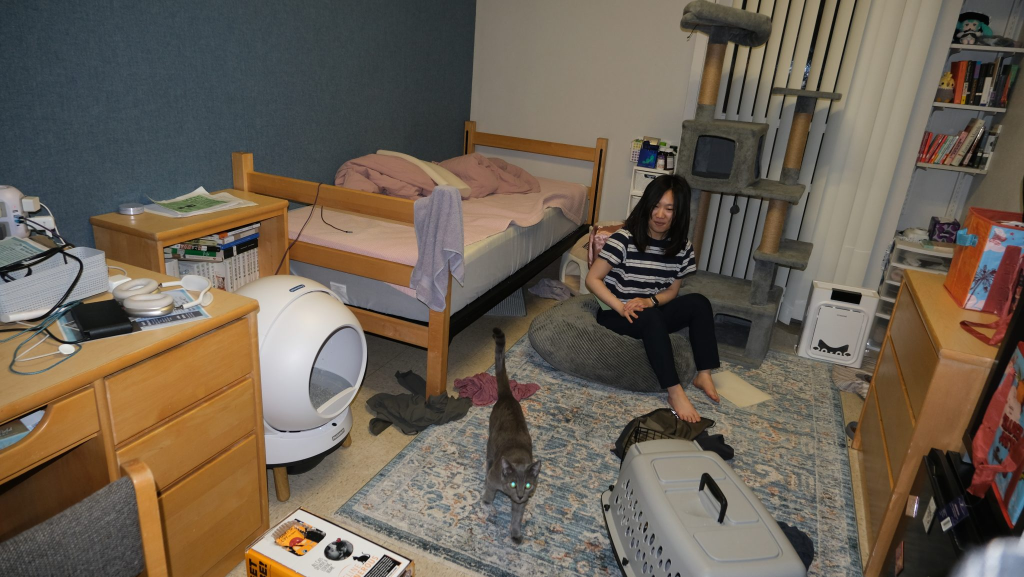
Maggie: Okay. If you could just give me a dorm tour, and then I’ll quickly interview you afterwards.
Sophie: Yes. So, um, hello.
Maggie: Do you want me to take my shoes off?
Sophie: Yes, yes, yes. Oh my goodness.
Maggie: Wait, what are the kitty names?
Sophie: Um, this one’s Nolo and the gray one’s Cu—Curu.
Maggie: Kubu.
Sophie: Yeah, C-U-R-U. They’re named after Tolkien elves.
Maggie: Wow, fancy water.
Sophie: Yeah, so they drink a lot of water and their kidneys don’t get hurt.
Maggie: I lowkey don’t give my cat water, and that’s on me.
Sophie: No. Anyways, yeah. So, hello. That is my desk. Um, that’s my laptop. Oh, that’s the iMac monitor that my dad got at a community college auction.
Maggie: Oh, you know, I just won a Nintendo Switch.
Sophie: Oh, lottery? From the lottery? Really?
Maggie: Yeah.
Sophie: Wait, wait, how?
Maggie: The Wig lottery. You can’t vote in it because you’re a sophomore—it’s only juniors and seniors.
Sophie: Oh my goodness. Wait, the one with the Switch?
Maggie: Switch 2. And they gave me Mario Kart.
Sophie: Wait, that’s awesome.
Maggie: Yeah.
Sophie: My friends and I have been playing Tomodachi Life.
Maggie: Wait, I want to get that.
Sophie: Yeah, like almost four hours the first week we got it. Every single night in a Japanese lounge. Yeah, we have like an album—a Google Photos album—of like 350 photos now, I think, and videos.
Maggie: Of what?
Sophie: Just us playing Tomodachi Life.
Maggie: Wait, can you share it with me? Unless you don’t want to.
Sophie: Oh yeah, of course. Just some of them—not all 350. I can just send you the link. A million people have looked at it anyway.
Maggie: Wait, I’m like—this is going to be me. I heard the Switch is so addictive.
Sophie: It is. It literally is.
Maggie: Wait, could you send these?
Sophie: Yes. We’re making professors and students—like real ones. Yeah, they’re all real ones. Except Quagsire.
Maggie: Wait, what professors are there any that I know?
Sophie: We have, um… we made Zhiru.
Maggie: Okay.
Sophie: But besides her, we have like all the Japanese department profs.
So this is me, this is someone named Eli, this is Shakriari, this is my friend Nathan, this is Josh, this is Shisha—you surely know Shisha—and this is my fictional daughter. This is Flu Kicker and Ya-sensei.
Maggie: I don’t know who those are.
Maggie: Oh hi [to cat]. He’s so pretty.
Sophie: He is. This is Flu Kicker and Takahashi. And this is Karita. It’s kind of funny because Takahashi and Karita are politically on opposite sides of the spectrum.
Maggie: Yeah. Oh, I know Josh.
Sophie: Then Josh supposedly has a crush on the Japanese language president.
Maggie: Wait, IRL?
Sophie: No, not IRL—in the game.
Maggie: Are you talking about Jesus?
Sophie: Well, okay. You know, I’ll just send you the entire app.
Maggie: Okay.
Sophie: Also, we need to meet for the um…
Maggie: Yes, yes, yes, we need some time. I can bring it to you. I just need to find it.
Maggie: Like I’ve seen it, I just need to find it and bring it to you. OMG.
Sophie: Okay. Is the room tour sufficient?
Maggie: Oh yeah, no, it’s sufficient. Maybe like—this is the cat tower. This is so cool. How do you like living in Oldenborg?
Sophie: I’ll really miss it.
Maggie: Why?
Sophie: I’ve honestly met so many friends here, and the structure of the Japanese community is special because it’s on the smaller side but also very tight-knit. Other language halls don’t have that. It just won’t be the same, you know?
Maggie: Yeah.
Sophie: I’ve also heard that the Japanese language hall is really tight-knit.
Maggie: Do you play the mahjong club?
Sophie: Oh yeah.
Sophie: Shixiao who runs the mahjong club and Josh—they both live in the Japanese hall.
Maggie: Yeah.
Maggie: Do you have any particular memories or things you want to share that you’ll miss about Oldenborg, or how do you feel about it being destroyed?
Sophie: Honestly, I’ll kind of miss even the asbestos.
Maggie: The what?
Sophie: The asbestos. Oh, it’s like this carcinogenic insulation chemical.
Maggie: Oh yeah. You’ll miss that?
Sophie: Yeah, because supposedly this whole building has toxic levels of it and that’s why they want to break it down. But yeah, I’ll miss my friends. I will very much miss my friends.
Maggie: But you’ll still have them.
Sophie: Yeah, but they’ll also be on study abroad or they’ll graduate. Yeah.
Maggie: You’re an interesting person, Sophie.
Sophie: I am?
Maggie: Yeah, of course.
Sophie: Really? There are deep and wondrous mysteries inside me.
Maggie: Okay, well thank you for your time.
Sophie : No problem.
Maggie: I’ll leave now.
Sophie: Thank you for coming to see my cat.
Maggie: I hope we can have a cat play day. Yes, my cat is going to be more shy. She’s so tiny.
Sophie: And these cats are only getting bigger. You’re getting so big, Nolo. Yeah, and it’s funny because Ku has a much bigger appetite than Kuru, but Nolo is tiny. According to the shitter box—that’s what it’s called in the litter box manager app.
Maggie: All right, I’ll see you.
Sophie: Okay, thank you. I sent you the link to the album.
Maggie: Oh, sick.
Sophie: You may parse through it.
Maggie: Thank you so much. Can I put some on the website?
Sophie: Yes, yes.
Maggie: Awesome. Thank you. All right, bye.
Maggie: Okay.
Sophie: Yeah. So these are posters made by the advanced language class. You’ll see a lot of them around. And these are all Pokémon drawings that Shixiao gave everyone personalized.
Then a while later, Eli, who is basically in charge of all the event planning and decorations for the Japanese lounge, printed cutouts for everyone. And everyone got a Japanese island.
Here’s an event that Nathan and I worked our asses off to put together. And this is photos from a kimbap-making event. It was supposed to be a cultural unity event between the Japanese and Korean communities, because Noi, who is the Japanese language resident, is quite fond of Korean culture.
Oh, here he is. Quag. King Quag. [laughter] Eli started the island gear for the advanced class. Yeah, Lizzy and then Addie.
Maggie: What were the Pokémon personalized based off of?
Sophie: Honestly, I think personality. Like me—I said I wanted a starter Pokémon and I was given Froakie. But to be honest, since I’m so deeply connected to Pokémon Sun and Moon, I would’ve preferred Rowlet. So Eli printed out a Rowlet for me and hid it somewhere in the hall and challenged me to find it. It was behind the red fire alarm right there. [laughter] And it was intentionally placed so a short person like me couldn’t see it.
But yeah, Eli also sometimes hides stuff up in the ceiling tiles.
And this was actually used as part of the Tomodachi Life addiction anti-addiction measure, because I’m someone who really struggles with addictive behaviors, including Tomodachi Life—because I am the owner of the Tomodachi Life Switch.
Maggie: Wait, you own a Switch?
Sophie: Yes. Yes. Yes. My parents brought it over as soon as they learned about the game because I begged them. They live in San Diego and were coming up anyway. The night before, I texted them like: “Mom, Dad, my friends and I really, really, really want to play Tomodachi Life and we need a Switch. Could you please bring the family Switch?”
And they did.
Maggie: Wow. Can you give me a tour of the Japanese lounge?
Sophie: Yeah.
Maggie: Wait, this is so nice. Wait, this door—yeah. Wait, the other lounges don’t have this?
Sophie: Yeah, by policy this is supposed to be locked, and everything inside here should be courtesy of Noi, but evidently that is not the case. Here we have Nomi’s paddle boards.
Here’s the remnants of boba that Kai got us two days ago from Sunright. Here’s my stuff. I have like two drinks left here. Here are my moss balls. I forget who these belonged to.
Maggie: Your what? What is that?
Sophie: Moss balls. Yeah, I had to put them out here as soon as the cats came in. And here’s my kettle / washing machine setup. Here are my cleaning tools, cat bowls, and my contributions to the Japanese hall. Everyone puts their food inside the fridge—even non-Japanese people, I think.
Maggie: Why don’t the other ones not have fridges?
Sophie: No accessible fridges, because the other language residents keep their kitchens locked.
Maggie: Oh wait, because the other ones have it inside their door, right?
Sophie: Yeah, but I think Russian and also Spanish lounges have a similar setup—kind of locked but technically still accessible—but the language residents keep them locked.
Also I think the Joy-Cons are currently inside here right now.
Maggie: The what?
Sophie: The Joy-Cons. The Switch Joy-Cons. They’re inside here so I can’t touch them. [laughter]
Maggie: Are they actually inside there?
Sophie: Yes, yes, yes. Nathan and Eli hid them in there last night and made me close my eyes. [laughter]
Maggie: Oh my god.
Sophie: Yeah.
Maggie: And how did you know they were in there?
Sophie: Because they were like, “Okay Sophie, close your eyes,” and they went into the kitchen. And I was like, okay, well, they hid it somewhere I can’t reach, and it’s not in here, so clearly it must be in there. And I literally can’t reach it anyway. I tried. I immediately figured it out. But yeah—one of the first times they hid it, Eli hid them inside the ceiling tiles, bro.
Monique Saigal, Professor Emeritus
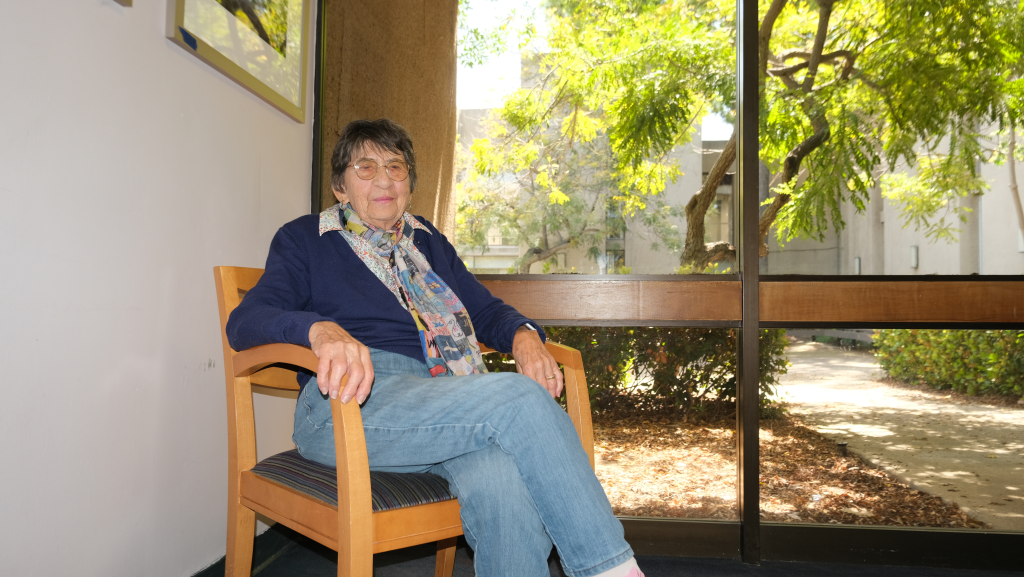
Monique: Oh, very well then. Yes, well, I arrived at Pomona College in Claremont in 1965. And Oldenborg was built in 1966, but I don’t remember the beginning of Oldenborg. That part I don’t remember.
What I can say is that there’s a difference between this year, the previous year, and what it was like when I used to come to Oldenborg, when I was teaching French. First of all, there weren’t as many people. There weren’t as many students, as many people in general.
And another thing that has disappeared is the tray. Back when I came to Oldenborg, there was a tray and you put whatever food you wanted on it. Then all of a sudden, well, maybe a few years later, there were no more trays. So I asked, “Why aren’t there any trays anymore?” They told us, “Students serve themselves too much food and don’t finish it.” So they thought that this way students would eat less and waste less.
That’s one thing I remember, you see. And there were fewer students from all over the place. Whereas now there are students from Africa, students from France, Spain, Brazil, Portugal, and so on. When I used to come to Oldenborg, they were all students from the United States, and there were fewer of us.
And then, well, I don’t really know what else to say about that. It’s just that now it’s much broader, much more international, let’s say. And now we teach languages. I can’t even pronounce some of the languages I see written on the little signs because I don’t know them, you know. Back then there was simply French, Spanish, German, perhaps Portuguese, I’m not even sure. But there weren’t all these African languages or other languages whose origins I don’t know. So the language tables were not at all as international as they are today.
The Oldenborg residents are going to be spread out in different places next year. But all these years, everyone was here together: the people who worked for Oldenborg, the residents, and the dining hall… Yes, that was all together. Maybe the food was a little better in the old days. But now the language tables are going to be separated too. Yes. The language tables are going to be at Frank. And, for example, the French resident… I was talking to him recently, and they’ve given him a little house on College Avenue.
Maggie: Wow.
Monique: You don’t realize how old I am, you know. Do you know how old I am?
Maggie: No.
Monique: I’m 88 years old. So my memory isn’t as good as yours.
Maggie: Ah, but are you sad?
Monique: Yes, I am sad.
Maggie: Why?
Monique: Because here, we’re all together. Not only do the students come from many different countries and many different backgrounds, and I love that. I find it enriching when people are different because we learn things we didn’t know before. And I think that’s wonderful.
But here, you have the director’s office, the people who work here, and then the residents who live upstairs on the second floor…
Maggie: Right, right, right.
Monique: So we’re less together physically. But I don’t know, because they want to make Oldenborg bigger.
Maggie: Oh!
Monique: And, for example, in the new Oldenborg there will be the dining hall, but there will also be classrooms where courses can be taught. There will also be spaces where guests can come and give presentations. There will be special rooms for that. So they want to expand it, they really want to make it bigger.
And I even saw, or heard, that next semester there will be too many students for the college to house.
Maggie: Yes, yes, yes.
Monique: So they’re telling students who are about to become sophomores that they can go to Europe through study abroad programs. You see, that’s a problem now.
Maggie: And I’ve heard that students are paying other students for better housing lottery slots. Up to $4,000.
Monique: Four thousand dollars? Oh my goodness! Is that for a single room? Can two people live there, or is it only for one person?
Maggie: Just one person. Because housing assignments are random.
Monique: Yes. But what I’ve noticed in everything we do is that there is a good side and a bad side. There are things we like and things we don’t like.
So in this new Oldenborg, maybe there will be certain things that we like. But I think what’s important is really trying to bring together students from different countries who speak different languages. Because that gives us a certain kind of peace.
Because right now, in the United States and in the world, wars are spreading. So it’s better to be with someone who is different, someone you can talk to. And perhaps we can prevent these kinds of things. Anyway…
Maggie: What kinds of topics do you talk about here with students in general?
Monique: Usually I ask them what their names are and which college they attend. Because some come from Scripps, CMC, even Harvey Mudd. Then I ask them what subjects interest them.
If they’re first-years, they may not yet know what they’ll specialize in, but I still ask: “What classes are you taking? What French class are you taking? Why are you taking that French class? And what do you intend to do when you write your thesis? Do you already have some idea of what interests you?”
Maggie: Do you like helping people practice the language?
Monique: Yes, I really enjoy helping others practice the language. And I don’t want to make them uncomfortable. Some students appreciate being corrected, and others feel embarrassed. So I’m careful.
For example, if someone says to me, “I go-ed to the store” [using incorrect French grammar], that’s not correct. But I reply, “Oh yes, so you’re saying that you went to the store, you see.” I repeat it that way so the student won’t feel embarrassed.
Maggie: Yes. Yes. Yes. I really notice that. And I remember that you’re always saying to me, “Do you understand? Do you understand?” And that’s incredibly helpful for me.
Monique: Well, I’m happy to hear that I’m doing something right.
So… what else can I tell you?
Maggie: Thank you.
Léonard Schnakenbourg, Last French Resident of Oldenborg
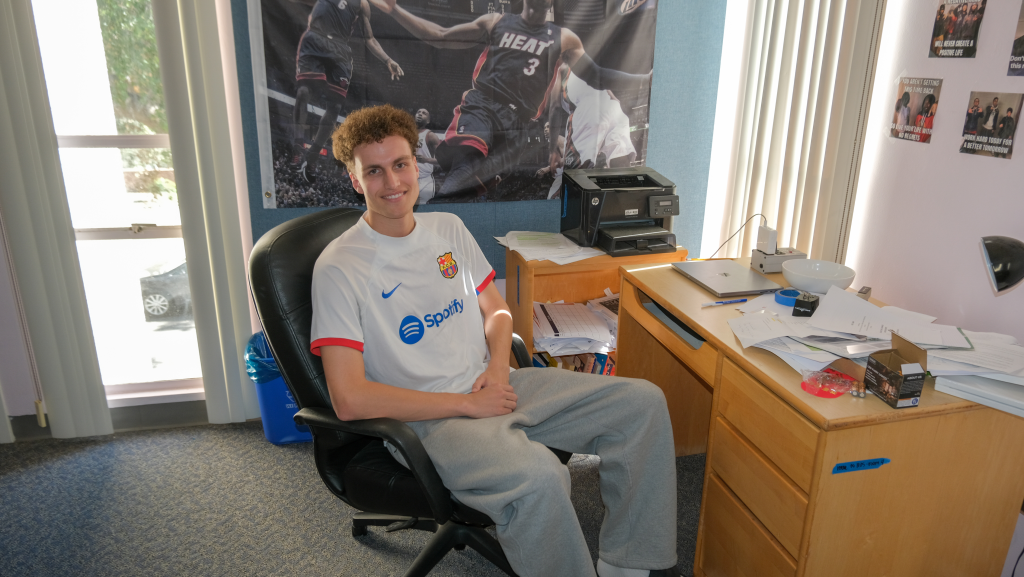
Leonard: Hi, I’m Léonard, and welcome to my place.
So, here there’s a small living area right behind the kitchen. It’s fully equipped.
A small table right here. It’s not very tidy, but that’s okay. Next, a small bathroom—just for me.
And finally—I think this is the most important part—a large bedroom for me. So, there you go.
Leonard: So, my name is Léonard; I’m the language resident for this year and next year as well. I
come from Nantes, a city in northwestern France, and my main role here at Oldenborg is to facilitate the use of French in my residence hall—so, with all the other students who want to speak French—and to organize events, but above all, to be present at the language table every day at lunch.
As for why I wanted to come here: I had always wanted to study or work in the United States. How did I hear about the position? There is actually a program that works with my university—sending language residents every year to universities all across the United States. But it was really Pomona that chose me, rather than me
choosing Pomona. So, I was very lucky to end up here, because I could have ended up in places that weren’t nearly as good.
I’ve really enjoyed my experience this year. Living among students who love French culture
and want to speak French is always a great experience. Organizing events was also a real pleasure, especially with people who were always enthusiastic and eager to participate. So, honestly, it’s been a wonderful
experience—one I’ll have many fond memories of. Oldenborg is unique because we live alongside other
language communities. So, it’s about being able to share our language—even with people who don’t live in our specific residence hall—whether they speak German, Chinese, Japanese, or whatever else. As for what I’ll remember most, I think it’s the “study breaks.” These happened once a month—usually evening activities I had to organize around French culture. We had trivia nights, mask-painting sessions for the Nice Carnival, and even made Madeleines—so, cooking activities. Those events where students came together for a fun, social time… that’s what I think I’ll remember most.
We learned early in the year that Oldenborg was going to be demolished at the end—that we’d be the last residents—because the building was too old; it was built back in the 1960s. It really is a bit of a labyrinth inside Oldenborg. So, they decided to tear it down and build a new, much more modern building that will be far better. I was a bit sad, but also happy to be among the last residents of the Oldenborg language house, since it’s actually quite a symbolic thing. So, uh, I was quite happy. But, uh, the fact that I’m staying next year and Oldenborg won’t be there anymore—I think the experience will be different.
Amri Gussenhoven, PO ’28
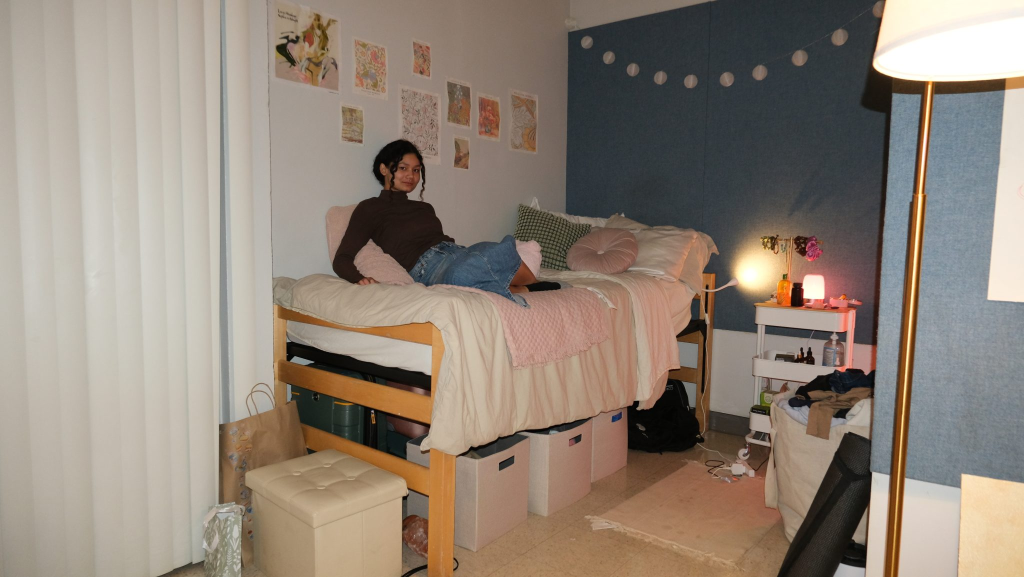
Amri: Hello. Should I introduce myself?
Maggie: Sure.
Amri: Okay, hi.
Maggie: Or I can interview you later, and then you can just give me a tour.
Amri: Okay, cool. So yes, welcome to my Oldenborg dorm. I’m in the French hall, and I’ve really loved living here so far. Last year was so sad. But yes, this is my room.
Wait, do you mind if I close the door? Wait, you can move your shoes. I love your shoes, by the way. Thanks for taking them off.
Okay, yeah. So is there anything that you want me to start with? Anything you’re curious about?
Maggie: Oh, well, tell me what this is.
Amri: Okay, so this is a giant mural that I DIYed from the Hive. I came in here, I saw these giant blue walls, and I was like, “Okay, how am I going to fill it up?”
I was thinking getting like this giant tapestry, but I found out that they had like these giant pieces of paper that are much cheaper from the Hive. And so I like in the first couple weeks of school, I sat down in the French lounge and I just like texted everybody and asked them to come and draw on this mural. So these are just like illustrations from all my friends. And then these are like um earlier in the semester, my friends um threw a half birthday party for me. Very kind of them. It’s because I have a summer birthday and they just wanted to celebrate me. So I also have like little notes written from them from the card that they made me on there. But yeah.
Maggie: And what about this station?
Amri: This station? Yeah.
Um yeah. So I have what can I start with? Okay. So I think this is called like I’m not going to lie, I honestly forget what the style of this little area thing is or what this little table is called. But I’ve always really loved tea, and as you can see I have a little teacup here, and so I like the idea of having like a little mini table.
Cuz like okay my room is pretty big and so I wanted to maximize the space as much as much as possible and so like I don’t know I have like this little chair here and like mediate the space.
Maggie: It would be crazy if you put the bed right here.
Amri: No way. That would that be — would suck. No like this was the original like the way that it is now was how it was when I first got in here and like the person they were correct I did not touch a single thing.
But yeah I like having tea and so I was like okay like I have these cushions here and this chair like what if I had like a little tea station and so yeah I have like some magazines here for you have like conversations here.
Maggie: Do you actually use this space?
Amri: Yes I do actually. Okay so this space in particular um I sectioned off my room or I planned it so like I would have like my academic space and like my sleeping space and this is also like my social space. So I wanted to create a cozy space for my friends to come and hang out. And so that’s specifically why like I got this little like the cushion, the chair, and also this rug is super soft so a lot of people just like sitting on it.
Maggie: What about your desk space or what’s on your walls?
Amri: My walls. Okay. So yeah I have um a piece that I drew for my drawing class last semester.
Maggie: Wait wait who was it with?
Amri: Uh Mercedes Teixido? Am I pronouncing her name correctly? I have no idea.
Maggie: I have no idea.
Amri: Yeah. I have notes from my friends. Um and then yeah on my desk wall I have a piece by one of my favorite esoteric artists, Helma A. Klimt. She’s well known for being a part of like the Theosophical movement.
And I’m part of the 5C Artist Coalition. And if you guys haven’t checked it out, it’s this really cool 5C club that’s dedicated to providing artistic resources to students from all the five C’s.
Maggie: You got two naked guys wrestling.
Amri: Yeah. Yeah. And so this was a really cool event that we had with um Mark Allen and Virginie Duzer across multiple departments and then I believe he was from off campus Dustin Stokes. But yes, amazing event, so provocative, so interesting. It’s a beautiful poster.
As you can see, we also have some very talented artists within the club itself. So you guys should totally check it out. Um but yeah I also yeah what else do I have up here I have I like collecting tarot cards and so this is a friend gifted me a card or a deck and this is one of the cards that I thought was just kind of I like the tree design.
And then um this is actually the back of another deck that I have or a card from another deck that I have but I also just like the design. Um and then I like poetry and so I have some really pretty book covers that I have that I or like book covers from poetry books that I had that I thought would make kind of like cool decor.
And then I drew these two guys a while ago and they’ve just been on like every single office space wall. They’re men.
Maggie: Guys?
Amri: Gender neutral. Okay I apologize I apologize I refer to everyone in like anything as a guy. Not a guy but guys.
Um and then yeah oh Leonardo also just I liked this picture in particular I think it balances out the brown on the wall. And then um wow color yes so much color.
I have another piece from Mercedes class last year. Um this is a letter from a friend. Um
Maggie: I won’t I won’t go on it. I won’t I won’t zoom in on it.
Amri: Oh yeah yeah yeah thank you thank you.
Amri: Um oh this was like so these guys I love Studio Ghibli Ghibli.
Maggie: Oh my god same
Amri: I should know is it Ghibli or Ghibli
Amri: I feel like it’s Ghibli.
Okay I’ve also said Ghibli but yes okay okay I got these little figurines and then this came with it and I was like oh this is kind of a cool little setup I like the colors it’s so cute.
And yeah um this is another this is a piece by I believe Benjamin Creme another esoteric artist that I kind of have been following for a little while. Um what else do I have here oh Paul Cézanne. And this is actually part of a larger poster collection that I have up above my bed.
Maggie: Cool.
Amri: But yes yeah I saw the colors in this cuz like it was one of those poster packs where they have like a bunch of different designs but like I think the majority of my favorite artists are in this pack like Gustav Klimt all-time favorite.
Um I love William Morris, Monet oh my god anyway yeah.
And then oh this is like another musical artist of mine I don’t know how to pronounce his name it’s going to be embarrassing I love so many people that I do not know how to pronounce the names of.
Um but yes this man N U G A B E S, New Gabis, New Jabes I don’t know.
Maggie: That looks hard I’ve never seen that.
Amri: He just makes like I think he’s known as like the father of what eventually became the lo-fi genre.
Maggie: Really?
Amri: He makes really like cool chill hip-hop beats
Maggie: I don’t know.
Amri: But yes I love his work. Um and then yeah this is what else what else should I talk about? Yeah I can talk on my bookshelf I have a lot of stuff there yeah sure um yes oops more little quirks yes.
Maggie: And then after this I’ll briefly interview also.
Oh sorry. Okay or yeah but yeah you can talk about the bookshelf
Amri: yes okay so like I said I love tea. So I keep all my tea here and then I have like my little tea station over there where I have like cups and little things.
Maggie: You’re never part of the tea club?
Amri: ???
Maggie: There’s a tea club that meets at the same time that ArtCo meets.
Amri: Oh the tea circle?
Maggie: Yeah that’s it it’s basically just a friend group that drinks tea together. They’re not meeting this semester but they might come back. They’re on Instagram.
Amri: I don’t know. I drink a lot of tea—cardamom cinnamon, honey ginseng, chamomile rose. Here’s my kettle. This is for a club I’m in, the Claremont Journal of Arts and Media. It’s oh
Maggie: I think I’ve heard of it.
Amri: Yeah it’s a oh wait you have maybe probably.
Maggie: Oh my gosh wait okay maybe I’m making that up.
Amri: You should totally check it out it’s a relatively new club but yes as you can see our theme is sea jam jam. Um and yeah I’m just keeping it with like my condiment station my tea station.
Amri: Um what else do I have I have oh acrylic paints that I honestly didn’t get to use as much as I wanted to this year. I used these to actually paint on the mural and I like had people come in and just like use them to paint whatever they wanted that was really fun.
Um and then I have some books that I got from both the Recoop in the beginning of the year and then like you know the Library Prison Project. Some of these books are also from there like this book um on women artists and I guess like how they have tried to like make their way into mainstream art especially because like women have been historically marginalized in the art world. Really interesting book.
Then I have yes some more art books. Like a manga book that oh I actually got this like I think oh my god I want to get into manga.
You I love okay manga was how I got into drawing actually like I just love the illustrations and that’s how I kind of started experimenting myself and I got this actually when I was in Quebec. Yeah okay this is a souvenir from Quebec I’m pretty sure this is in French. Yes oh my gosh French manga fun.
Okay um and then yeah poetry books Emily Dickinson. Um what else do I have more English and poetry books.
Um oh Anton Chekhov I got this from the Recoop I’ve been enjoying his work um yeah what else what other books. Mary Oliver well not really like a poetry book I have my English teacher in high school gave me like a book on her like a poetry handbook so her advice as to how to write poetry but not a book of her actual poetry but like that’s fine I love her.
Um yeah oh and also this really I have yet to read this but it’s like it’s called Roger Casement’s Diaries and it’s basically the diary of this um he was an he was a martyr from Ireland who was hung by the British um for his social advocacy against colonial rule. Yeah I mean I’m a sociology major so this
Maggie: I did not know that are you a double major
Amri: Yeah I’m trying wish me luck. Um but yeah I don’t know this just sounded really interesting because I just like I feel that’s such an interesting like obviously he was a martyr so he’s going to have some huge weird monumental impact or whatever but I like I think from the perspective of reading his diary in particular you can really get into his brain and just like who he was as a human versus a historical figure.
So I thought that was really cool. And then oh my gosh this is um what is this this is okay I got I thought this was a work by Claude Monet and that’s why I got it like that other random it’s a different club it’s not Claude Monet. I was misled I was so excited.
Um this is actually okay so it’s actually really interesting it’s about this guy who talks about I guess like his experiences supposedly going to the afterlife. Um yeah so I mean not Claude Monet but still very very intriguing Claude and also the cover is really the cover is so misleading I don’t know why they would use this like random impressionist work in Claude’s book like are you serious. Um but still like really interesting read. And then oh my gosh my friend gave me the original Howl’s Moving Castle and this has been like serotonin.
Maggie: Wait can you flip through it?
Amri: Yes wait I’m not I don’t know how to do it like aesthetically was that good?
Maggie: Oh I thought there would be images I don’t know why.
Amri: Oh no unfortunately but this was like I don’t know who illustrated this or if this was based off the Ghibli version but it’s just from that I don’t know. Mhm cool cool yeah.
Maggie: Do you want to briefly interview about Oldenborg?
Amri: Sure.
Maggie: So, if you could just tell me your name, your year, the hall that you live in, and your relationship to Oldenborg—whether it’s the dorm, the language hall, events, the tables. Yeah, that’s my first question.
Amri: Okay, yeah. My name is Amri. I’m a sophomore and I live in the French hall.
My relationship to Oldenborg… I think it’s kind of funny because I started learning French when I was like seven years old. I wouldn’t say I’m perfectly fluent—I’m still learning—but I’ve always been really passionate about languages and learning about different cultures.
I come from a very multicultural background because I’m mixed, so that international perspective means a lot to me. And I think Oldenborg embodies that in a lot of ways.
Even though I’m from the French lounge, I’ve been able to go to a bunch of events from different halls, and that’s been really cool. There’s very much a broader Oldenborg community, even with the separate language communities. It’s this shared spirit of really embracing and learning about different cultures.
Even last year, a lot of my freshman dorm hallmates ended up migrating to Oldenborg, which is kind of funny. We were a really good group, and everyone in the hallway was friends basically.
It’s funny because everyone there was also really passionate about language learning, or at least open to it. Before we all moved to Oldenborg, I would practice French casually with friends who spoke Spanish or who just wanted to learn French, or people would casually speak different languages for fun.
So yeah, I’ve really loved living here. The amenities are pretty good, I love my room layout, I love having my own bathroom, and the people here are really cool.
Maggie: I thought you were going to talk about the mold.
Amri: Oh no. Okay. I was being really genuine in everything I said, but I also feel like I sound like an Oldenborg brochure.
Like it feels a little too programmed. But yeah, Pomona has had some technical issues this year.
Maggie: There was mold in your bathroom?
Amri: Okay yeah—so I didn’t actually take care of it, my roommate did. But apparently for like an entire half of the semester there was black mold growing on our ceiling.
I just didn’t look up, I guess. Then she told me like, “Oh yeah, maintenance came earlier because I had to deal with the black mold,” and I was like, “What? The what?”
And yeah… I’ve been living here with black mold.
Other than that, I think Oldenborg has been fine. There have been campus-wide outages and things, but not just this building.
At some point we didn’t have water specifically on our wing. I don’t really know what was going on there.
But yeah, I think Oldenborg is architecturally complex. That’s actually a really unique aspect of the design.
Maggie: It’s hard to get robbed.
Amri: Exactly. That’s what I was saying—it’s actually really secure.
Although, if we’re talking about negative experiences, this wasn’t mine personally, but apparently there was an older man—definitely not from the 5Cs—who somehow got into my hallway on the second floor of the French hall.
He was just wandering around and writing Hindu non-dualistic messages on the community wall.
I didn’t talk to him, but he was right outside my door, and also right outside my roommate’s door.
She stepped outside while he was working on the wall, and he asked her something like, “Is this dorm only for students or do TAs live here too?”
I don’t remember exactly what she said, but aside from the writing—which I think was questionable but also kind of philosophically interesting—I was also confused by the situation.
Especially because he was asking about TAs, and I’m not sure why.
My friend said he was older, maybe had a silver ponytail, and didn’t seem fully sober or mentally stable.
So I hope he’s okay. I just don’t really know what was going on.
Maggie: How do you feel about Oldenborg getting destroyed?
Amri: Honestly, it’s bittersweet.
On a practical level, I’d live here again. The amenities are really good. If I can have air conditioning and my own bathroom on a campus where that’s not guaranteed, I’ll take Oldenborg.
The room size is decent, the closet space is good, and the windows are nice.
On a sentimental level though, I do feel a bit conflicted. I know the community is moving to Lorry, so it’s not disappearing completely.
But I think I’ll miss the chaotic, kind of quirky memories tied to the building.
For example, people joke about the basement bathrooms being creepy. It kind of becomes a rite of passage.
I remember at the beginning of the year we joked about having horror movie nights down there, because it really does feel like the perfect setting for that. There’s even a broken arcade machine downstairs.
Maggie: Also, I actually left my camera outside—I’m just going to go check really quickly. Sorry, I got paranoid.
Amri: No, that’s fair.
Amri: I think I’ll miss the weird parts of Oldenborg the most.
It’s kind of like a sibling relationship. You bicker, it’s messy, sometimes unpleasant, but you still love it.
Even if it annoys you, that bond stays there.
Oldenborg has really discombobulating architecture, but that’s also what made it special.
When we all got here, that was something we bonded over—getting lost.
A lot of my friends who don’t live here find the basement kind of terrifying. And honestly, it is.
There’s a broken arcade machine, a bunch of locked rooms—it’s basically a horror film setting.
I think there was even a student horror film project down there where they were putting fake blood on the walls and using smoke machines, and they accidentally set off the fire alarm at like midnight.
So yeah, it’s those kinds of moments I’ll miss.
Also just being with friends in communal spaces, blasting music in the lounge, having mini dorm parties until like 3 a.m.—those kinds of things won’t really be possible in the same way anymore.
But I’ve seen the designs for the new building and they’re really nice.
Oldenborg is old. Even if we kept it, I think I’d be fine living here another year… we can just deal with the black mold.
But yeah, it’ll be sad to see those memories physically disappear.
Maggie: Awesome. Thank you so much.
Derek Kyan, PO ’28
Vivienne: Okay. Can you tell me your name and your class?
Derek: My name is Derek Kyan and I’m a Pomona sophomore.
Vivienne: Okay. Um, first, could you just tell me a little bit about what Oldenborg means to you?
Derek: Sure. Oldenborg is a space where I can connect with a bunch of people from around the world. You’re never going to meet someone from the same two places in Oldenborg. And especially in my hall, I have everyone who is from across the states and also people from Taiwan and like different parts of China as well. I live in the Chinese hall, so I’ve been able to connect with a lot of those students and it’s just really nice to live in a space on campus where I can talk to people in Chinese and also share the same culture with them as well.
Vivienne: Um, and then do you have like an experience or memory that has stuck out to you while living there?
Derek: A memory that stuck out to me is a lot of times like my Chinese resident — there’s a lot of dinners, and so for Chinese New Year we would make rice balls. It’s called tangyuan and it’s like a dessert for Chinese New Year, and we all made it together and it was like a good memory because we had a lot of tangyuan that night and then we also had karaoke.
But it’s not just like events that happen within my Chinese hall. We also like stuff that I do with my friends in Oldenborg. My friend Alassie has like a friendship suite, so sometimes I would just like sleep over in her lounge and we would just hang out the whole night and like hang out in different rooms in Oldenborg.
Vivienne: Thank you. Okay. And then my last question is, um, if you have any thoughts on them tearing Oldenborg down.
Derek: I think Oldenborg should be the last building that they tear down on campus. Like, I think the rising sophomores are going to — they’re missing out on Oldenborg next year, and I feel like I’m going to be really sad and I’m going to miss my single in Oldenborg, and it’s just like you’re never going to experience that again.
But I’m excited to see what the new building will be after I graduate. And I hope that Oldenborg will continue to be the space it is today.
Gene Yu, Community Member
Ella: Okay. First, do you mind introducing yourself?
Gene: Hi, I’m Gene. Gene Yu. And I’ve been attending — well, dining at Oldenborg — for, well, this is my 16th year attending Oldenborg.
Ella: Okay, that’s incredible. That’s wild. Um, and how many languages do you speak?
Gene: I speak a handful, and most of them quite badly. But I can get by traveling overseas without using English in several countries.
Ella: Okay. Which languages?
Gene: Which doesn’t mean I speak those languages very well. Which means you need very little to travel, as long as you don’t mind making a fool of yourself. As long as you enjoy doing that.
Ella: Okay. Um, do you mind saying which languages specifically?
Gene: Sorry. Um, I grew up in Korea, so Korean is my mother tongue, so obviously I can do that. And I had a couple of years of Chinese and a couple of years of Japanese. And we will find out about my survivability in Japan very soon because I’ll be leaving just next week for Tokyo. And Chinese — I think I’m a little less ready to try, but it’s even more basic than my Japanese I think. But I’m willing to give it a go.
But I’ve traveled in Germany, France, Italy quite comfortably using those languages. And then some Russian — well, Russian, that would be very interesting to find out. I’m sure I can find a way to survive somehow, if I can get in there safely and get out of there safely. Yeah, at this point maybe Ukraine might be a better choice, or one of those ex-Soviet republics.
I could probably survive in the Netherlands with my basic Dutch. The only thing is they speak English so well, so it’ll be hard for them not to switch to English right away. But I have actually gotten by with Dutch in the Netherlands years ago.
Ella: Okay, so to round up, we have Dutch, Chinese, Japanese, Korean, Russian, French, German, Italian — something like that?
Gene: And at one time I could have probably done okay with my Swedish, but I’ve let it go. But again, they speak better English than many Americans.
Ella: Okay. What got you into language learning? What made you want to — I think we were at eight — try to learn eight languages?
Gene: I think I like connecting with different people from different backgrounds. I don’t know, it’s just fun for me. I don’t know why I don’t speak any of those very well, but I still enjoy just speaking to people from different backgrounds in their own language and just making them laugh or smile.
Ella: Wow, that’s beautiful. I love that. Um, what was your first experience with Oldenborg? How did you learn about Oldenborg or language tables at Pomona?
Gene: I moved down here from Oregon. Even though I did live in California years ago — a few, three decades ago. But I was living in Oregon at that time, and I was living very close to the University of Oregon campus. And there I attended something similar — not to this scale — but I used to go to this pizza place where German speakers met once a week. I think that was Wednesday night or something like that, at a place called Tracktown Pizza. And then another night of the week we met for French, and another night for Italian.
So when I moved down here I was looking for an opportunity similar to that, and this is what I found online, and this just turned out to be something quite spectacular. I never expected this — five days a week during the semester. And back then lunchtime started at 11:30 and they would kick us out around 1:15. So we had a lot of time. So I did two or three tables per day some days.
Ella: Oh my gosh. Um, so you said 16 years of Oldenborg?
Gene: This is my 16th year. So 15 full years. And that has actually helped me maintain some of the languages, because without this I wouldn’t have had the chance to practice regularly.
Ella: Can you speak more about that — how Oldenborg has impacted your language learning, and then also maybe connections with other people at Oldenborg?
Gene: You can take language courses, but if you’re not either traveling in your target countries or meeting with a group of people who speak that language, then you lose it so quickly, so easily. Even though it’s such hard work to acquire languages, losing them is so easy, it happens so quickly. So when I came here, attending Oldenborg’s language tables enabled me to maintain and even improve some of my languages without even taking the courses — particularly German, I think.
Ella: Okay. Do you have a favorite Oldenborg memory, or a person you’ve met at Oldenborg that being here has helped you get closer with, or something like that?
Gene: Yeah. Both my wife and I have been coming here. Well, my wife joined me just a couple of years ago when she started taking Japanese. So she started coming in more regularly, and she has been really getting close to her classmates. And we go on outings for dinner, or to Koreatown, or to — what’s the name of the observatory in LA?
Ella: Griffith?
Gene: Griffith Observatory — or various places. And so I’ve been spending quite a bit of time with them, and play pickleball with some of them, and we keep in touch sometimes even during vacation. I find that very pleasurable and productive, very satisfying. And some of them I see graduate, and then some of them keep in touch after they get their jobs. So it’s great.
Ella: So it’s been a place for connections as well as language.
Gene: Exactly. Yeah. Really good connections with a lot of people from different parts of this country and different parts of the world.
Ella: Do you think that Oldenborg — obviously it seems like you’ve traveled a lot and have had a lot of interactions with people from different places — but do you think that Oldenborg has improved your global mindset, cultural awareness, or something like that?
Gene: I think it certainly has. Yes. And they also have many OLC speakers from different parts of the world, speaking on different topics — particularly global topics quite a bit — and many international students here from different countries. So just being here, when we don’t have the opportunity to travel, it’s like traveling the world just being here almost.
Ella: Okay. Maybe a last question. Um, do you plan to engage in whatever the next iteration of Oldenborg is, or do you have any hopes about the new project, or any worries about kind of losing the Oldenborg we have now?
Gene: I think they have very good plans for the future of Oldenborg — really expanding the current Oldenborg and making it bigger and modernizing it. So I think that can only be good, and I really look forward to that. And we want to be a part of that as well.
In the meantime, I’ve heard that the language tables will continue, as part of Frank or some of the dining halls here. And hopefully we won’t lose the momentum — the students won’t lose the momentum of living in language halls and dining at language tables — because I think Pomona College is probably at least one of the best in the world for doing something like this. I don’t know of any others, maybe except for Middlebury possibly. I haven’t been there, but I hear they have very good programs. So we have something really, really special — something we can’t even call unique, I think — and I look forward to the bigger and better version of that.
Ella: Perfect.
Shixiao Yu, PO ’28
Maggie: If you could just tell me your name, your year, kind of like how long you’ve been living at Oldenborg, like any memories you have associated with it, and like how you feel about it being destroyed and stuff.
Shixiao: Hi, my name is Shixiao. I’m a sophomore and I’ve been living in Oldenborg for one year, the 2025 to 2026 school year. I think Oldenborg is a great place, mainly because it provides — well, especially I think for the Japanese language hall, which I live in — the community is very tight-knit, and a lot of that’s facilitated by the fact that we live so close to each other and the Japanese lounge is very convenient, right down the hall. So a lot of us will stay there and study together. Oldenborg also provides many resources, such as for example the go sets and shogi sets that we use to play games and connect with each other. And I like the fact that it’s very convenient to go to the dining hall as well.
Um, about it being torn down — I’m sad about it obviously, but a lot of that is also because of extenuating circumstances, such as the fact that it’s more difficult to get housing for next semester, or that we won’t have it for the next two years that I’ll be on campus. But I think it’s a good thing that they’re planning on renovating it and making it hopefully a better place to live in, like less prison-like, you know?
Maggie: You think that it’s prison-like?
Shixiao: Just a little bit.
Maggie: Okay. Um, are there any like memories that you’ll have of Oldenborg that will stay with you?
Shixiao: Many of the memories that I have are associated with the people and the things that I’ve done in Oldenborg, such as the conversation classes. I took Japanese conversation class last semester and we filmed a cooking show that was in the Oldenborg kitchen, and that was very memorable. A lot of the study breaks as well are done in like the glass room or the kitchen, places like that.
Salvador Peña Nissenblatt, PO ’29
Vivienne: Okay. Um, so can you tell me a little bit about what Oldenborg means to you?
Salvador: Um, in the beginning when I started going to Oldenborg, I was always really nervous. And I felt intimidated by all of the people at the tables, but I began to make friends and it became such a huge pillar of community. And I began to go like multiple times a week and I was so excited to go. So I guess Oldenborg is a very special place for community for me. Yeah.
Vivienne: Um, could you tell me about like a memory or an experience that has stuck out to you or meant a lot to you?
Salvador: I remember this one time last semester — I go to Oldenborg for Japanese and Spanish, but I was at the Japanese language table. And I stayed for a really long time afterwards, like probably close to 2 PM, even though technically Oldenborg closed at 1 or whatever. But I just stayed there talking with the language resident and this senior, about the language and about Oldenborg and about the experience of learning a new language. And it’s such a fond memory for me because it made me realize how Oldenborg is not just about practicing the language, but it’s about the people who make up the language tables and the experiences they’ve had and the wisdom that they’re willing to share with other people.
Vivienne: My last question is if you could share any of your thoughts on Oldenborg being torn down this year.
Salvador: Um, I’m really sad about it. Even though I’m a freshman and I just got here, I really like the building and I like the space, and it’s going to be sad to have the language tables in Frank next year. It just won’t be the same. But like I said before, it’s the people who make up Oldenborg. So maybe — I definitely think it’ll still be a great place to go, but I am sad that it’s being torn down.